Hello everyone! Its been a lot of sculpting and casting, but I have some cool stuff to reveal: a small shot of the Robot v.3 and the Astronaut v.1!
The robot is going through one more round of sculpting to make everything sharp and clean, and the astronaut should be at least version 2 or 3 before its ready for production.
Let me know what you think! I should have more detailed photos coming soon.
Thursday, April 25, 2013
Thursday, March 7, 2013
School Spirit and Robots: Part 2/2
The principal's phony warmth finally subsided, yielding to bitter hostility. She informed Crystal that, as a minor, she lacked the right to bring charges to court, and— worse—that her parents would surely understand such charges to be counter- productive. Crystal's throat burned. With a little leeway for her description of the emperor's-new-clothes effect on Crystal's parents, the principal, for the first time on record, had spoken the truth.
“You are dismissed,” said the principal, gathering up Crystal's precious data and eyeing an office paper shredder.
Now, Crystal knew that all her data was backed up—better backed up than almost any other data on Earth. But the gesture of separating her from her printouts struck an emotional chord. Crystal knew how to stand up for herself, and saw no reason to tolerate such abuse. She stood and demanded to be given her papers back. Her voice did not quaver.
About this time the Japanese boom box rose from its corner in Crystal's bedroom. A number of shocked neighbors later reported that it had power-walked out of the neighborhood and along the shoulder of the six-lane suburban through-street toward the junior high school. Had it malfunctioned? Was it somehow sharing the young Ms Fern's emotional impressions? Or perhaps the device had run calculations on Crystal's conversations about her school, and had finally determined that she was unsafe bringing her charges to her school administrators, even during school hours.
Back in the principal's office, Crystal flinched sideways as the video camera lurched out of its corner. She tripped over the arm of her chair, and a veritable tree of chrome unfolded and towered over her. Any commands the robot was following must have been sub-vocal, because the principal could not manage a word as she, too, rose wheezing from her triple-cushioned conforming-plastic swiveling office chair with built-in massage, and lurched forward.
There are some urges that prove universal among all teenagers, and one of them is that, when a goon reaches out to grab you and your authority figure encourages him to do so, you run. Crystal found her feet, found the doorknob, and inexplicably managed to dodge the video-camera robot's grasping hands. In its enthusiasm to catch the insolent student (although what could be so wrong about demanding a hardcopy of information one already has, we may never find out) the robot slammed its shoulders into both sides of the doorframe—a thud reverberated throughout the school. The video camera head turned back and forth rhythmically, whirring, while the contraption adjusted its shoulders to a more likely angle. Crystal, never athletic to begin with and hardly given to the anorexia expected of a girl her age, was spurred to an uncomfortable dash, squeezing between desks, bureaucrats, and Xerox machines toward the hall, but before she got there, she glanced back over her shoulder to see the principal wedged into the doorframe along with the robot, exceptionally red in the face, perhaps from exertion, perhaps from squishing up against all those steel protrusions.
Crystal was no one's fool. Once free, that robot would be more than a match for her puny adrenaline-fueled sprint. Where could she turn for safety? There was no hope of reaching home in time, but, regardless, the first step was to exit the school.
Exit she did, unnerved by the empty hallways—she had hardly ever seen them with fewer than eighty people competing over every square foot—and she was greeted by her trusty boombox, its lurid glory exaggerated by the midday sun. The poor machine's protocols were in a state of confusion, and rather than playing an indie-rock passage or borrowing the voice of a movie star, the robot bellowed, “I'm here! What's your status?” in a soothing, unfamiliar tenor. Where did this new voice come from? Was it evidence of true ingenuity on the part of an Artificial Intelligence? Do robots even have their own “real” voice? Philosophical concerns such as this were far from Crystal's
mind. In crisp, punchy sentences, she outlined her original hopes for the day, her disappointment, and the childish dispute over the papers, which she realized were now lost. The robot reassured her that it had backups of the data, and this time the thought helped to calm her.
The principal, in due course, interrupted their happy reunion, storming through the outer doors with one hand held up behind her to keep the video-camera robot at heel. Given the machine's crowning decoration, she looked remarkably as though she were warding off members of the press, using her hand to shield her face from the lens. But her signaled orders only carried so much weight to her computerized servant; like many full-size robots, this one carried an obligation to protect its master from physical harm if possible. Danger to the principal would override her own orders. Worse, the principal's influence had bent the robot's programing until it, too, valued damage to her reputation almost as dearly as damage to her flesh and bone.
The principal's video camera approached Crystal, lens full of menace. Crystal's loudspeaker placed itself in between.
The video camera is not a communicative device by nature—only receptive. But the little red light that indicated it was filming blinked more furiously than it had ever blinked before. The loudspeaker, which is communicative by nature, squealed a Led Zeppelin guitar riff. At this point most of the student body emptied from their classrooms, and scurried in all different directions until some of them, by chance, came out the front doors and became witnesses to the world's first contest of this type.
The two robots, finally at liberty to use their full strength, clashed together at lightning speed, each desperate to protect their own charge and furious to reach their target. Their long legs stamped into the grass, pistons shrieking, trying to find the best purchase. Their slender arms whooshed up to each other's shoulders and then down toward each other's legs, like time-lapsed wrestlers trying now for a pin, now for a throw.
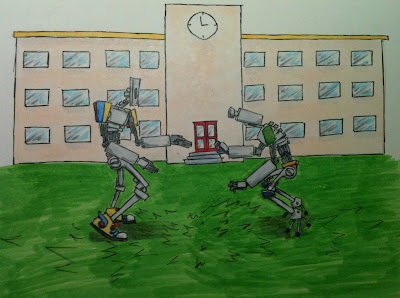
Thinking an alarm of some kind was going off (fire? carbon monoxide? what sound does a “despicable administration” alarm make?) the remainder of the student body rushed outside. Among the first was the notorious Jimmy Green. Shrugging his hands deep into his pockets, he looked at Crystal; looked at the robot; looked back at Crystal, and smiled charmingly.
Green knew nothing of her detective work, or of the principal's reaction, but perhaps it was obvious to him that some abuse of power was taking place. Perhaps he couldn't tell, but jumped to the conclusion that Crystal was staging justified resistance, because he wanted to believe that. Perhaps he had severely overindulged in basketball on TV.
“Foul play,” he said, simply, and the robot, as though it had been waiting only for someone to show they understood, went quiet.
By Valery Grue
Friday, February 8, 2013
School Spirit and Robots: Part 1/2
Due to a mistake with the shipping company, or maybe all the way back at the assembly line, Crystal Fern's actual present on her thirteenth birthday—you know the one: the one that you've discussed not only with your parents but with your aunts and uncles beforehand, pleaded and bargained for, which they've agreed is part of life for a new generation of kids your age, next to which all the other presents this year are filler material intended to assuage your sense of entitlement, indicating that for some reason they don't understand you would gladly go three years without so many knickknacks in exchange for this life-changing boon—that present—her actual present, a Japanese boom box whose main speaker measured no less than ten inches, arrived at her suburban Illinois home welded to some kind of modernist chrome case whose paint was limited to a deeply un-hip pattern of silver and primary colors. Needless to say, the girl's sense of place in the world was shaken. Had she done something wrong? Was this visual assault some sort of test that she was meant to overcome?
And, if she left things as they were, would she garner short-lived abuse from her friends when they saw the garish thing, or would she be thoroughly socially crucified?
Crystal's mother got mad at the company. Crystal, unfortunately, was old enough to press her as to which company she held responsible—retail, or manufacturing?—a question that led her mother to simultaneous shouting and hedging, a combination made in Hell. Her father stood deferentially to one side and pointed out that a speaker's stand does not affect the sound it makes. He gestured at the stand with both hands open, as if to emphasize the thing's functionality by making box-shapes in the air. Anything can sit on top of a box. Crystal and her mother were still shouting, ignoring his eloquent hands, when, as though to prove that it was not just a box, the stand, stiffly, stood.
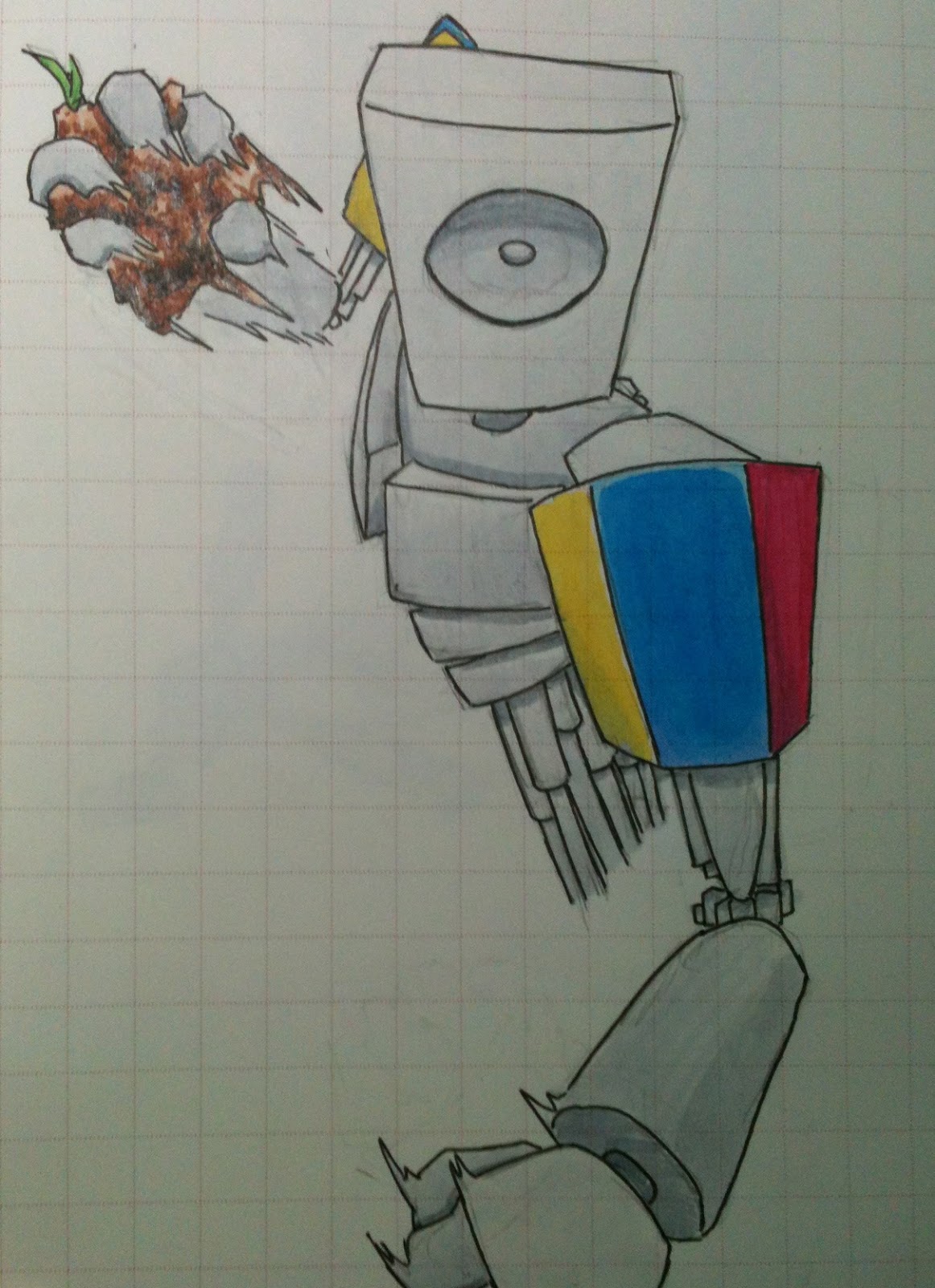
First it rocked forward slightly, balancing its full weight on oversized toe and heel treads. The long, segmented legs then straightened, compact tapering knee joints smoothly took on the machine's untold weight, the arms were forced apart slightly from where they had hugged the tongued-and-grooved shins. Hydraulic cylinders hissed, turbines whirred to life and pistons extended. Lowering its arms for the first time to its sides, the robot (with the confident clumsiness of a newborn colt) knocked three cardboard boxes, a wad of wrapping paper, a plush pony and a bar of mediocre chocolate off of the mantle and into the hands of mother and daughter, silencing both, and demonstrating once and for all the exceptional compensatory environmental subroutines (“instincts”) of its make and model.
No matter where a robot is intended to deploy, or what task it is intended to fulfill, every robot's underlying purpose (the very word deriving from a Russian term for “servant”) is to serve humanity: to give them what they want, make them happy, or even facilitate their haphazard efforts to make themselves happy. In this case, Mrs. Fern craved an object to mother, smother, and/or nurture, while Crystal felt a void of respectful emotional support, relative to her maturity. (I'll bet you thought the chocolate had gone to her mother, and the pony to Crystal, didn't you? See, sometimes robots know humans better than we know ourselves.)
Before long, the robot was Crystal's confidante and bodyguard on her walk to and from high school. She told it how Jimmy Green's voice, having finally stabilized, incited unfamiliar, intriguing feelings in her, and how Nancy Evans' brand of kissing up to her teachers disgusted her more than ever this year, as she was beginning to realize that, no, her career opportunities were not determined by how she performed in class— or at least (she widened her eyes wisely) not by her test scores. In return, the robot broadcast the alternative-rock radio station, put on the hit single from the latest Clingy Snazz record whenever her friends were around, and carried her books, the family sofa, and the engine block of her Volvo (when it started to smoke one day) to wherever they needed to go.
But just as social acceptance had underpinned Crystal's original obsession with her stereo, the robot's programming extended to monitoring its master's emotional health and, by extension, her reputation. The main threat to Crystal's health, as she reveled in her official teenager status, was a fledgling understanding that her authority figures compulsively lied to her.
For two months after her birthday, Crystal had the robot draw publicly available data from the school district's records, and read it to her in the voice of Humphrey Bogart. These searches came up disappointingly empty to the scandal-hungry teenager. Not long after she abandoned the searches, though, and after a vitriolic debate with Crystal's aforementioned rival, Evans, which had started as accusations of cheating on tests but had touched on the drugs finding their way into the school's football program, the robot determined that Crystal's mental health would be more stable if she better understood the pathways of finances and power in her school. Without understanding a single byte, the robot compiled a table of asymmetrical funding, individuals wielding power, and a deduced graph of how they might connect, and after an awkward rendezvous with the family's printer, presented a hardcopy to Crystal that night.
However rewarding her gratitude may have been to her servant's circuits, this had the unintended effect of a new argument the next week, this time between Crystal and her school principal, to whom she had presented indisputable proof of her boss's corrupt activities.
Crystals parents would hear of the scandal, and of the argument, only after it was too late to prevent the fight's escalation.
The high-school sleuth was surprised to see an awkward chrome stand holding an expensive video camera in the corner of the office—but she kept her shoulders back as she took her seat, and explained her evidence in a steady voice. The fat, pencil eyebrowed principal straightened the lapels of her voluminous navy blue blazer, and a red light began calmly blinking on one side of the video camera, as if responding to some sub-vocal signal. In a deceptively amiable tone of voice, the principal attempted to interrogate Crystal: how had she come by these data? was she involved in a quarrel with another student? perhaps a family member? did she possess professional-grade surveillance equipment? and why had she begun investigating the school district administration to begin with? But the girl hedged, avoided, and answered questions with questions, trying to bully the principal into responding to her accusations. She revealed nothing of her hi-fi assistant.
And, if she left things as they were, would she garner short-lived abuse from her friends when they saw the garish thing, or would she be thoroughly socially crucified?
Crystal's mother got mad at the company. Crystal, unfortunately, was old enough to press her as to which company she held responsible—retail, or manufacturing?—a question that led her mother to simultaneous shouting and hedging, a combination made in Hell. Her father stood deferentially to one side and pointed out that a speaker's stand does not affect the sound it makes. He gestured at the stand with both hands open, as if to emphasize the thing's functionality by making box-shapes in the air. Anything can sit on top of a box. Crystal and her mother were still shouting, ignoring his eloquent hands, when, as though to prove that it was not just a box, the stand, stiffly, stood.
First it rocked forward slightly, balancing its full weight on oversized toe and heel treads. The long, segmented legs then straightened, compact tapering knee joints smoothly took on the machine's untold weight, the arms were forced apart slightly from where they had hugged the tongued-and-grooved shins. Hydraulic cylinders hissed, turbines whirred to life and pistons extended. Lowering its arms for the first time to its sides, the robot (with the confident clumsiness of a newborn colt) knocked three cardboard boxes, a wad of wrapping paper, a plush pony and a bar of mediocre chocolate off of the mantle and into the hands of mother and daughter, silencing both, and demonstrating once and for all the exceptional compensatory environmental subroutines (“instincts”) of its make and model.
No matter where a robot is intended to deploy, or what task it is intended to fulfill, every robot's underlying purpose (the very word deriving from a Russian term for “servant”) is to serve humanity: to give them what they want, make them happy, or even facilitate their haphazard efforts to make themselves happy. In this case, Mrs. Fern craved an object to mother, smother, and/or nurture, while Crystal felt a void of respectful emotional support, relative to her maturity. (I'll bet you thought the chocolate had gone to her mother, and the pony to Crystal, didn't you? See, sometimes robots know humans better than we know ourselves.)
Before long, the robot was Crystal's confidante and bodyguard on her walk to and from high school. She told it how Jimmy Green's voice, having finally stabilized, incited unfamiliar, intriguing feelings in her, and how Nancy Evans' brand of kissing up to her teachers disgusted her more than ever this year, as she was beginning to realize that, no, her career opportunities were not determined by how she performed in class— or at least (she widened her eyes wisely) not by her test scores. In return, the robot broadcast the alternative-rock radio station, put on the hit single from the latest Clingy Snazz record whenever her friends were around, and carried her books, the family sofa, and the engine block of her Volvo (when it started to smoke one day) to wherever they needed to go.
But just as social acceptance had underpinned Crystal's original obsession with her stereo, the robot's programming extended to monitoring its master's emotional health and, by extension, her reputation. The main threat to Crystal's health, as she reveled in her official teenager status, was a fledgling understanding that her authority figures compulsively lied to her.
For two months after her birthday, Crystal had the robot draw publicly available data from the school district's records, and read it to her in the voice of Humphrey Bogart. These searches came up disappointingly empty to the scandal-hungry teenager. Not long after she abandoned the searches, though, and after a vitriolic debate with Crystal's aforementioned rival, Evans, which had started as accusations of cheating on tests but had touched on the drugs finding their way into the school's football program, the robot determined that Crystal's mental health would be more stable if she better understood the pathways of finances and power in her school. Without understanding a single byte, the robot compiled a table of asymmetrical funding, individuals wielding power, and a deduced graph of how they might connect, and after an awkward rendezvous with the family's printer, presented a hardcopy to Crystal that night.
However rewarding her gratitude may have been to her servant's circuits, this had the unintended effect of a new argument the next week, this time between Crystal and her school principal, to whom she had presented indisputable proof of her boss's corrupt activities.
Crystals parents would hear of the scandal, and of the argument, only after it was too late to prevent the fight's escalation.
The high-school sleuth was surprised to see an awkward chrome stand holding an expensive video camera in the corner of the office—but she kept her shoulders back as she took her seat, and explained her evidence in a steady voice. The fat, pencil eyebrowed principal straightened the lapels of her voluminous navy blue blazer, and a red light began calmly blinking on one side of the video camera, as if responding to some sub-vocal signal. In a deceptively amiable tone of voice, the principal attempted to interrogate Crystal: how had she come by these data? was she involved in a quarrel with another student? perhaps a family member? did she possess professional-grade surveillance equipment? and why had she begun investigating the school district administration to begin with? But the girl hedged, avoided, and answered questions with questions, trying to bully the principal into responding to her accusations. She revealed nothing of her hi-fi assistant.
By Valery Grue
Click here to read the action packed finale!Friday, January 25, 2013
WIP: Astronaut and Camera-Head
Here are some pictures of the astronaut's torso featuring robot heads and arms, to show how the combination of parts might look on the final figures. The sculpts are a lot closer to completion, especially on the robot parts.
Lastly, here is a very early sculpt of the third figure, wearing a camera head! It is a suit person. Maybe a business person, or a robot wearing a suit, or anything! It really suits a lot of options! Ba dum bing!
Thursday, January 17, 2013
New Desk
While I work on some illustrations for a new story, here are some pictures of my desk! Its pretty clean at the moment because the desk is new. Before this, I worked on a little wobbly warped card table.
Here are the toys watching over me while I work.
Thursday, December 20, 2012
King Castor Fan Art and Story!
On the october toys OMFG forum, (Here) the fan -PookeyG- has been making some awesome fantasy stat cards and storylines for the OMFG figures! He just got around to King Castor, and it looks super awesome. The story is great as well!
Thank you, -PookeyG-!
King Castor
Usually made from an old castle or disused brick fortress, King Castor is the final resting place for a magic user who has not lost the will to fight, only the ability.
Rudimentary steam engines are haphazardly attached to these structures to give them some mobility. After they are prepared, a disabled magic user (typically a witch or wizard who has grown too old and feeble to walk) is brought inside where they perform a last ritual in which their spirit is bound to the brick structure thereby giving it life. A face resembling the magic user emerges from the bricks outside of the area where the witch or wizard was interred.
Despite powerful engines, King Castors are always extremely slow. Their brick bodies are strong and sturdy, but also extremely heavy. Typically this is not too large of a hinderance in battle. The power of the interred witch or wizard is only amplified by the now large and more sturdy building.
Despite these stone buildings being nearly timeless (barring any outside force of destruction) they are not exactly ideal for the interred magic user. They require constant upkeep. The fires in the steam engine must be ablaze at all times. Should the fire go out, the King Castor shall be immobile and the spirit of the witch or wizard that animated it shall be trapped until the fires are re-lit. If the animated fortress can sustain a large enough crew, it can also be outfitted with cannons and other incendiaries.
Work crews responsible for upkeep typically live in the chambers inside of the King Castor.
If the structure is completely destroyed, the spirit of the magic user remains on earth until armageddon. As such, most magic users prefer death and passing in the next world. Only the most stern and vengeful opt for interring as a King Castor.eNd
Thank you, -PookeyG-!
Saturday, December 15, 2012
WIP: Old vs. New
Here are some current pictures of what I am working on!
Currently I am making the robot nice and sharp for production. Some details were removed, others added onto, but I think the overall shape of the being is much nicer to look at.
For comparison, there is the previous version of the part.
As you can see by the other pieces lying about, all the parts of the robot are being updated.
I am trying to be a little more slow and steady on the Astronaut so that in one go it will be production-ready.
Only time and effort will tell, though!
As a bonus, here is a preview of the third robot head, as well as the third figure!
Currently I am making the robot nice and sharp for production. Some details were removed, others added onto, but I think the overall shape of the being is much nicer to look at.
For comparison, there is the previous version of the part.
I am trying to be a little more slow and steady on the Astronaut so that in one go it will be production-ready.
Only time and effort will tell, though!
As a bonus, here is a preview of the third robot head, as well as the third figure!
Subscribe to:
Posts (Atom)